Component libraries
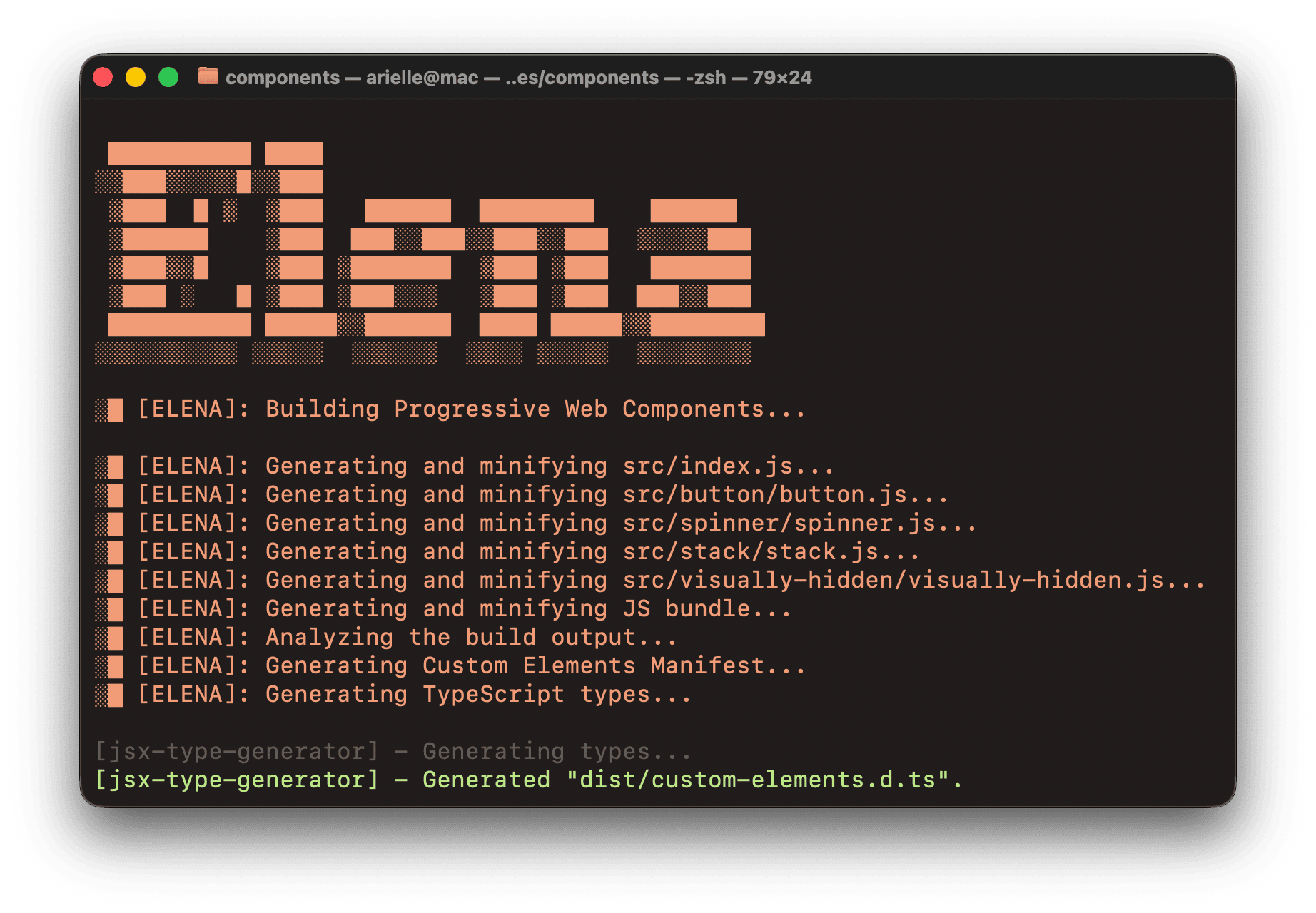
@elenajs/bundler is the build tool for publishing Elena component libraries. It bundles JavaScript and TypeScript source files, minifies CSS, generates a Custom Elements Manifest, and produces TypeScript declarations for each component.
Install
npm install --save-dev @elenajs/bundleryarn add --dev @elenajs/bundlerpnpm add --save-dev @elenajs/bundlerbun add --dev @elenajs/bundlerCLI usage
The bundler provides an elena binary with build and watch commands:
npx elena buildTo start a watch session that rebuilds on file changes:
npx elena watchFlags
| Flag | Description |
|---|---|
--config <path> | Path to a config file. Defaults to elena.config.mjs or elena.config.js in the project root. |
Configuration
Create an elena.config.mjs (or elena.config.js) at the root of your package:
/**
 * ░█ [ELENA]: Bundler configuration
 *
 * @type {import("@elenajs/bundler").ElenaConfig}
 */
export default {
  // Source directory scanned for .js/.ts entry files and .css files.
  input: "src",

  // Rollup output options.
  output: {
    dir: "dist",
    format: "esm",
    sourcemap: true,
    filename: "bundle.js",
  },

  // Entry for the single-file bundle. Set to false to disable.
  bundle: "src/index.js",

  // Additional Rollup plugins appended after Elena’s built-in set.
  plugins: [],

  // Custom Elements Manifest options. Set to false to skip entirely.
  analyze: {
    plugins: [],
  },

  // Browserslist targets for transpilation. Enables syntax transforms
  // (e.g. class fields, optional chaining) to widen browser support.
  target: ["chrome 71", "firefox 69", "safari 12.1"],

  // Custom Terser minifier options, merged with the defaults.
  terser: { ecma: 2020, module: true },

  // Banner comment prepended to bundle output files.
  // Use a @license tag so minifiers preserve it.
  banner: `/** @license MIT */`,

  // Controls how components are registered.
  // "auto" (default) preserves .define() calls in the output.
  // "scoped" strips .define() calls and generates a register.js helper.
  registration: "auto",
};
Options
| Option | Type | Default | Description |
|---|---|---|---|
input | string | "src" | Source directory to scan for .js, .ts, and .css files. |
output.dir | string | "dist" | Output directory for compiled files. |
output.format | string | "esm" | Rollup output format. |
output.sourcemap | boolean | true | Whether to emit sourcemaps. |
output.filename | string | "bundle.js" | Output filename for the single-file bundle. The CSS bundle filename is derived by replacing the .js extension with .css. |
bundle | string | false | "src/index.js" | Entry point for the single-file bundle. Auto-detects src/index.ts if no .js entry exists. Set to false to disable. |
plugins | Plugin[] | [] | Additional Rollup plugins appended after the built-in set. |
analyze | object | false | { plugins: [] } | CEM analysis options. Set to false to skip Custom Elements Manifest generation, TypeScript declarations, and JSX types entirely. |
analyze.plugins | Plugin[] | [] | Additional CEM analyzer plugins. |
target | string | string[] | false | false | Browserslist target(s) for transpilation. When set, enables syntax transforms (e.g. class fields, optional chaining) via @babel/preset-env. Example: ["chrome 71", "safari 12.1"]. |
terser | object | { ecma: 2020, module: true } | Custom Terser minifier options, merged with the defaults. See the Terser API docs for available options. |
banner | string | false | false | Banner comment prepended to index.js and bundle.js output files. Use a @license JSDoc tag so minifiers preserve it. |
registration | "auto" | "scoped" | "auto" | Controls how components are registered. "auto" preserves .define() calls in the output. "scoped" strips .define() calls and generates a register.js with a defineAll(registry?) helper for scoped registry usage. |
Build output
Running elena build produces:
| File | Description |
|---|---|
dist/*.js | Individual ES modules for each source file. |
dist/*.css | Minified individual CSS files. |
dist/bundle.js | Single-file JavaScript bundle (optional). |
dist/bundle.css | Concatenated and minified CSS bundle. CSS files imported as CSS Module Scripts (with { type: "css" }) for Shadow DOM are excluded. |
dist/custom-elements.json | Custom Elements Manifest describing all components. |
dist/custom-elements.d.ts | JSX integration types mapping tag names to prop types. |
dist/*.d.ts | Per-component TypeScript declarations with typed props and events. |
dist/register.js | Registration helper with defineAll(registry?) and re-exported component classes. Only generated when using registration: "scoped". |
TIP
CSS files that are imported as CSS Module Scripts (import styles from "./button.css" with { type: "css" }) for Shadow DOM use are automatically excluded from bundle.css. These files are instead inlined as CSSStyleSheet objects in the JavaScript output. Individual .css files are still emitted.
Scoped registry builds
When registration: "scoped" is set, the bundler strips .define() calls and side-effect component imports from the output. Components are exported as bare classes, and a register.js helper is generated:
export default {
  registration: "scoped",
};
The generated register.js exports a defineAll() function and re-exports all component classes:
import { defineAll } from "@elenajs/components/register";

const registry = new CustomElementRegistry();
defineAll(registry);
You can also import individual classes for selective registration:
import { Button, Spinner } from "@elenajs/components/register";

const registry = new CustomElementRegistry();
Button.define(registry);
Spinner.define(registry);
This can be useful when multiple versions of the same library need to coexist on a single application. See Scoped registration for more details.
TypeScript support
The bundler supports both JavaScript and TypeScript source files. When .ts files are detected in the source directory, the bundler automatically transpiles them via @rollup/plugin-typescript. The output is identical to what you get from JavaScript sources.
To use TypeScript, write your components with inline type annotations instead of JSDoc:
import { Elena, html } from "@elenajs/core";

export default class Button extends Elena(HTMLElement) {
  static tagName = "elena-button";
  static props = ["variant"];

  /**
   * The style variant of the component.
   * @property
   */
  variant: "default" | "primary" | "danger" = "default";

  render() {
    return html`<button>${this.text}</button>`;
  }
}
Button.define();
A tsconfig.json is required in the project root. A minimal configuration:
{
  "compilerOptions": {
    "target": "ES2020",
    "module": "ESNext",
    "moduleResolution": "bundler",
    "skipLibCheck": true
  },
  "include": ["src"]
}
TIP
The bundler handles TypeScript declarations separately via the CEM analyzer. You don’t need declaration: true in your tsconfig.json.
See the TypeScript page for more on using and consuming the generated types.
Programmatic API
The bundler exports its internals so you can integrate it into your own build scripts:
import {
  createRollupConfig,
  runRollupBuild,
  watchRollupBuild,
  createCemConfig,
  runCemAnalyze,
} from "@elenajs/bundler";
Sub-path imports are also available:
import { createRollupConfig, runRollupBuild, watchRollupBuild } from "@elenajs/bundler/rollup";
import { createCemConfig, runCemAnalyze } from "@elenajs/bundler/cem";
createRollupConfig(options?)
Returns a Rollup configuration array. Useful if you want to wrap or extend the config in a custom rollup.config.js.
runRollupBuild(config)
Runs both build phases (individual modules + optional single-file bundle) programmatically.
watchRollupBuild(config, opts?)
Starts a Rollup watch session that rebuilds on file changes. Returns the Rollup watcher instance. Pass opts.onRebuild as an async callback to run after each successful rebuild (e.g. to re-run CEM analysis).
createCemConfig(options?)
Returns the Custom Elements Manifest analyzer configuration object.
runCemAnalyze(config, cwd?)
Runs the CEM analysis and writes custom-elements.json, custom-elements.d.ts, and per-component .d.ts files.
Example library
@elenajs/components is a reference component library built with Elena. It demonstrates real-world component patterns and is available as a starting point for your own library.
npm install @elenajs/componentsyarn add @elenajs/componentspnpm add @elenajs/componentsbun add @elenajs/componentsIt includes the following components:
| Component | Tag | Description |
|---|---|---|
| Button | <elena-button> | Renders a <button> or <a> with variants, states, and icons. |
| Spinner | <elena-spinner> | Animated loading indicator that inherits the current color. |
| Stack | <elena-stack> | Flexbox layout wrapper with configurable direction and gap. |
| Visually Hidden | <elena-visually-hidden> | Hides content visually while keeping it accessible. |
Usage
Import the full bundle to register all components:
import "@elenajs/components";Or import individual components for better tree-shaking:
import "@elenajs/components/dist/button.js";
import "@elenajs/components/dist/stack.js";
Each component has a matching CSS file:
@import "@elenajs/components/dist/button.css";
@import "@elenajs/components/dist/stack.css";
Or import the full CSS bundle:
@import "@elenajs/components/dist/bundle.css";When a library is built with registration: "scoped", import from register.js to control where components are registered:
import { defineAll } from "@elenajs/components/register";

const registry = new CustomElementRegistry();
defineAll(registry);
The source code is in packages/components/ of the Elena monorepo and serves as an example of how to structure, build, and publish a library with @elenajs/bundler.
Next steps
- Explore Framework Integration examples for React, Vue, Angular, Next.js and more.